Six Decades of Duct Tape: What Inspections Reveal When a 1950s Ranch Meets a 2010s Build
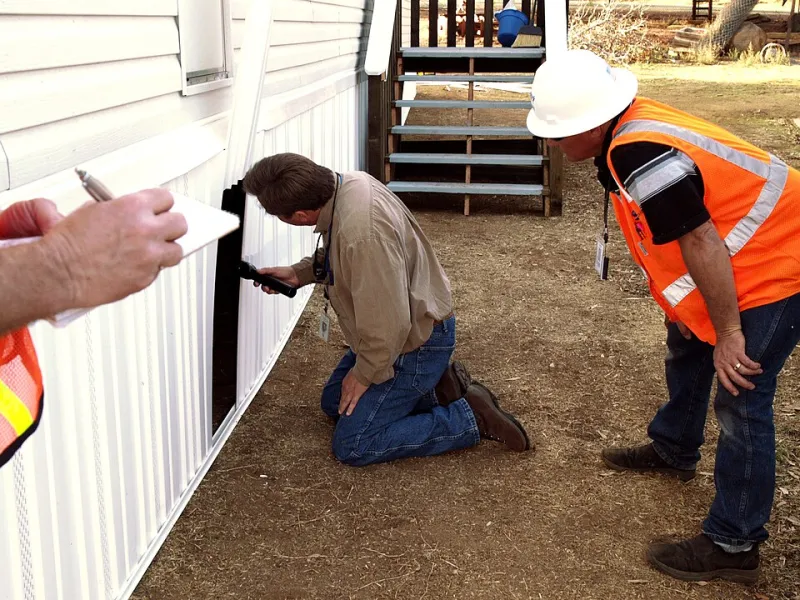
Photo: Amanda Bicknell, Public domain, via Wikimedia Commons
Two buyers, two houses, one week. The first purchases a 1950s ranch on a mature street in the older part of town; the second closes on a 2014 colonial in a subdivision that did not exist when the ranch was built. Both order general home inspections. Both reports run about thirty pages. And yet the two documents might as well describe different planets.
Understanding what an inspection is likely to uncover — before you order one — helps you budget realistically and negotiate with confidence. Here is how the two eras compare.
What the Mid-Century Report Usually Says
Homes built between 1945 and 1965 were constructed with materials that were, in many cases, genuinely superior to what followed: full-dimension lumber, plaster, and old-growth framing. But the mechanical systems were designed for a different century, and inspectors know exactly where to look.
Electrical. Knob-and-tube wiring, common through the 1940s, lacks a ground wire and is often buried under decades of attic insulation. Even homes that have been "updated" frequently retain partial circuits. A full rewiring of a 1,500-square-foot ranch typically runs $8,000 to $15,000; a panel upgrade from 60 or 100 amps to 200 amps adds $2,000 to $4,000.
Plumbing. Cast-iron drain lines corrode from the inside out, and galvanized supply pipes restrict flow over time. Repiping in copper or PEX generally costs $5,000 to $12,000. Inspectors will also flag original sewer laterals — a $5,000 to $15,000 repair if the line under the yard has failed.
The envelope. Asbestos was standard in flooring, duct wrap, and sometimes insulation through the early 1970s. Testing costs a few hundred dollars; full abatement of a basement's worth of duct insulation can exceed $4,000. Add to that single-pane windows, minimal insulation, and foundations that have spent seventy years settling — hairline cracks are normal, horizontal ones are not.
None of this makes the ranch a bad buy. It makes it a known quantity, and known quantities can be priced.
What the Newer Build Report Usually Says
A 2010s house passes inspection with fewer red flags — but the flags it does raise follow a pattern.
Builder-grade everything. Contractors working at subdivision scale often installed the cheapest acceptable version of each component. Expect inspector notes on undersized HVAC units, fifteen-year water heaters already past midpoint, and composite decking that has faded unevenly. These are wear items, not defects, but they arrive on a schedule.
Shoddy finishing. The most common modern findings are cosmetic-but-telling: missing flashing at deck ledgers, improperly pitched gutters, bathroom exhaust fans venting into the attic instead of the roof. Ventilation mistakes are the serious one — they cause mold and rot that can cost $3,000 to $10,000 to remediate if caught late.
The neighborhood itself. Newer subdivisions sometimes share systemic issues — one siding product, one window manufacturer, one batch of HVAC units. If the inspector finds a problem, ask whether neighbors have the same one. Production-build defects are rarely unique to your lot.
Pricing the Trade-Off
The mid-century home typically shows a longer repair list with larger individual line items, offset by land value, lot size, and location that newer builds cannot match. The 2010s home shows a shorter list, but you are often paying more per square foot for a smaller lot and a longer commute.
A useful exercise: take both inspection reports and price every finding above $1,000, then add a 15 percent contingency to each. For a well-maintained ranch, that total often lands between $20,000 and $40,000. For a newer build in average condition, $8,000 to $15,000 is more typical. Whether the ranch's lot, character, and school district justify the difference is not an inspection question — it is a priorities question.
Using the Report in Negotiation
Inspection findings are leverage. Era-specific repairs — a failing sewer lateral, a builder-grade water heater — are exactly the kinds of items sellers expect to concede on, either through a credit or a repair before closing. What carries less weight are findings that are simply characteristic of the home's age: old wiring that works, cosmetic settling, dated bathrooms. Frame requests around safety and function, not taste, and you will get further.
The inspection is not a verdict on the house. It is a price tag on its history — and its shortcuts. Read it that way, and either era can be the right purchase.